
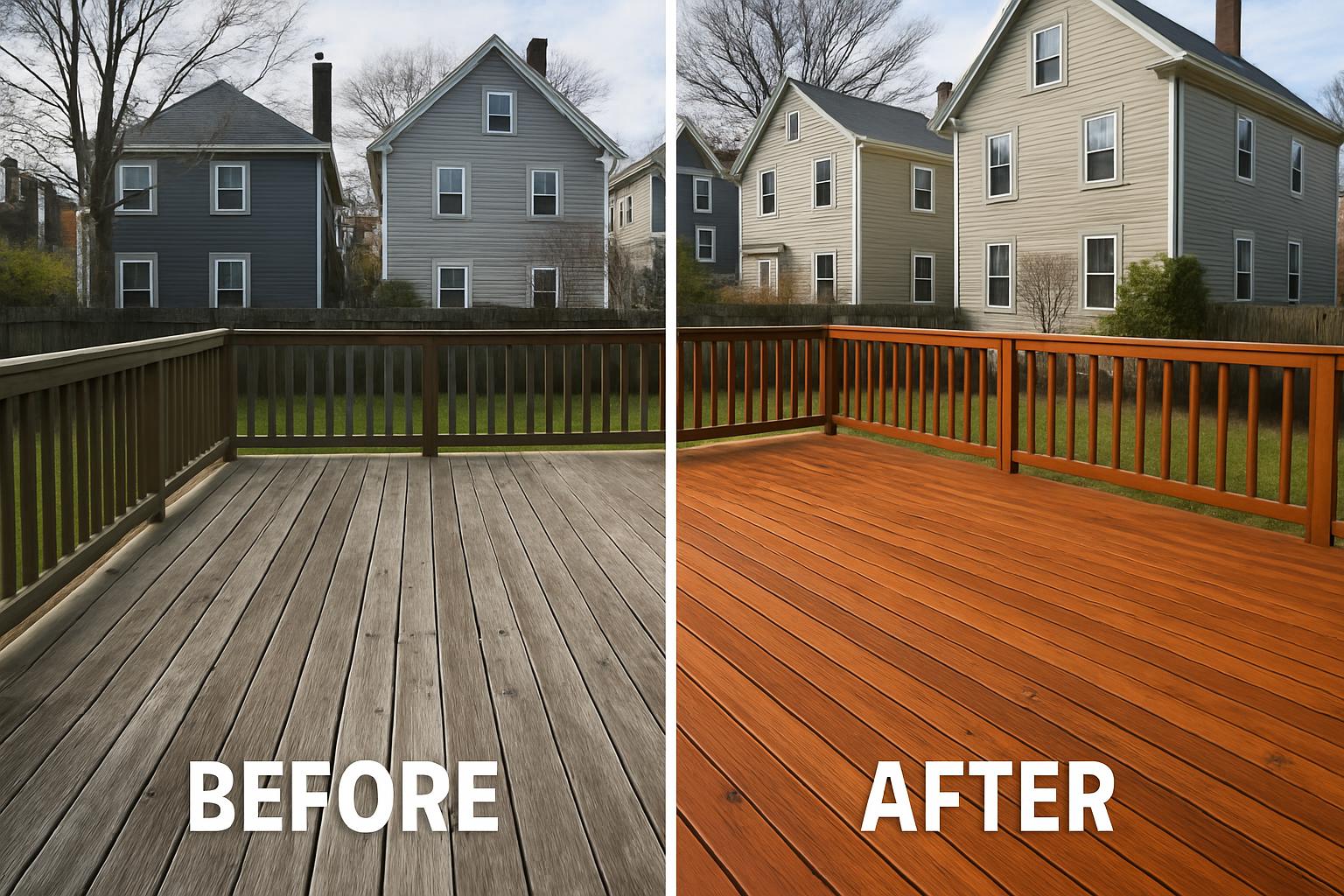
Introduction: The Battle Against Boston’s Weather
For homeowners in the Boston area, a wooden deck is not just an outdoor space; it’s a valuable extension of the home, a place to enjoy the rare and beautiful summer and fall months. However, the New England climate is relentless. The combination of harsh winters, snow, ice, the constant freeze-thaw cycle, and intense summer humidity poses a continuous threat to the integrity and beauty of your wood investment.
Exposure to these elements without proper protection quickly leads to rot, cracking, warping, and the gray fading that devalues property. That’s why deck staining and sealing is not a luxury, but a critical necessity for any home in the Metro Boston area.
In this complete guide, Boston Paint & Power, your local painting and power washing expert, details everything you need to know to protect your deck. We will cover everything from the science behind wood protection to choosing the best products for the Massachusetts climate and the meticulous process that ensures your deck’s longevity. We position ourselves as industry specialists, ensuring you have the knowledge needed to make the best decision for your home.
Why Deck Staining and Sealing Are Crucial in Boston, MA?
Wood is an organic material that reacts drastically to environmental changes. In the Boston, MA region, where the four seasons are well-defined and extreme, deck protection must be an annual or biennial priority.
The Harsh Winter and the Freeze-Thaw Cycle
The main enemy of your deck is water. During winter in Metro Boston, water penetrates the wood fibers. When temperatures drop below freezing, this water freezes and expands, creating internal pressure that leads to cracks and splinters. This freeze-thaw cycle, repeated dozens of times each winter, destroys the cellular structure of the wood.
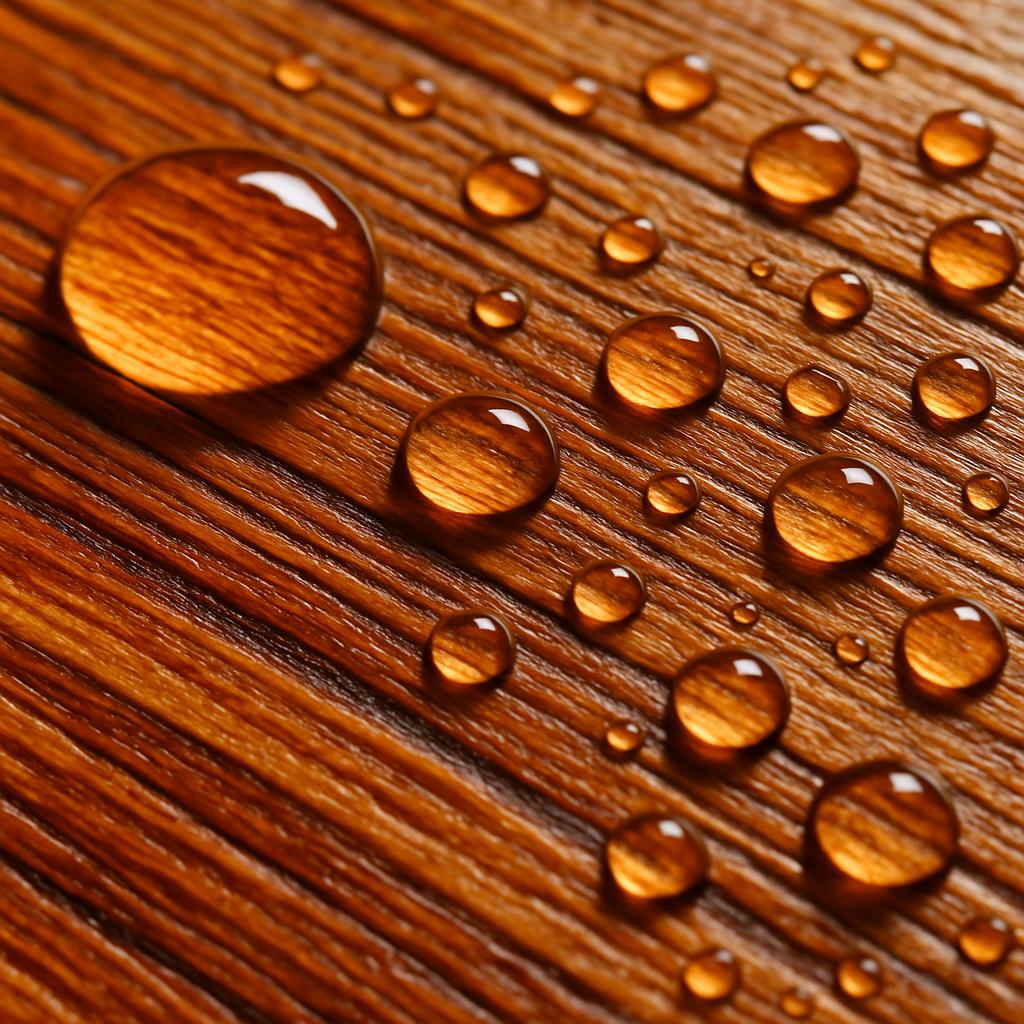
Deck sealing creates a hydrophobic barrier that prevents water penetration, protecting the wood against structural damage caused by ice. Without this protection, your deck’s lifespan can be cut in half [1].
The Threat of Humidity, Mold, and UV Rays
Besides the cold, humidity is a constant problem. High summer humidity and frequent rains create an ideal environment for the growth of mold, mildew, and algae, which not only make the deck slippery and unsightly but also accelerate wood deterioration.
Staining, especially with products containing UV inhibitors, protects the wood from the sun’s rays. Constant sun exposure (even on cold winter days) breaks down the wood’s lignin, causing it to lose its natural color and take on that gray, worn look. A good sealant with UV protection slows this process, maintaining the surface’s color and integrity for longer [2].
Boston Paint & Power Difference: We understand that the New England climate demands more than a superficial application. Our process is designed to withstand these extreme conditions, ensuring that the protection penetrates deep into the wood.
Choosing the Right Stain and Sealer for New England Weather
The choice of product is the most important factor for the durability of your deck staining project. Generic products will not withstand the Massachusetts climate. You need a high-quality, water-repellent product with excellent UV protection.
Product Types: Oil, Water, and Hybrids
There are three main categories of deck staining and sealing products:
| Product Type | Base | Advantages for Boston | Disadvantages |
|---|---|---|---|
| Oil-Based Stains | Oil (usually linseed or tung oil) | Penetrates deep into the wood, nourishing it and offering superior protection against moisture and cracking. Ideal for older, drier woods. | Slower drying, more difficult cleanup, can be more volatile. |
| Water-Based Stains | Water (Latex/Acrylic) | Fast drying, easy cleanup with soap and water, less odor. Excellent color retention and mildew resistance. | Does not penetrate as deeply as oil, can peel if preparation is not perfect. |
| Hybrids (Oil-Water) | Combination of resins | Offers the best of both worlds: the penetration of oil with the ease of cleanup and fast drying of water. An excellent modern option. | Generally higher cost. |
For the New England climate, deep penetration and water resistance are crucial. That’s why many professionals in the Boston area still prefer high-quality oil-based or hybrid products, as they offer the best defense against moisture and the freeze-thaw cycle [3].
Transparency and Color: Which is Best for Your Deck?
The choice of color affects both aesthetics and UV protection:
- Clear/Transparent: Only seals the wood, maintaining the natural appearance. Offers the least UV protection. Requires more frequent reapplication (every 12-18 months).
- Semi-Transparent: Contains pigments that add subtle color but still allow the wood grain to be visible. Offers good UV protection and is the most popular choice for decks.
- Semi-Solid: More pigment, less visibility of the grain. Excellent UV protection.
- Solid (Paint): Completely covers the wood grain, acting more like a paint. Offers maximum UV protection and durability, but loses the natural wood texture.
Recommendation for Boston: For most decks, a high-quality semi-transparent sealant is the ideal balance between beauty and protection.
Recommended Brands for the Boston Area (and why)
Boston Paint & Power uses only premium materials that are proven to withstand the local climate. Some brands that stand out in New England include:
- Sherwin-Williams Deckscapes: A popular and reliable product, especially the semi-transparent version, known for its fade resistance.
- Benjamin Moore Arborcoat: Offers a complete line, including solid and semi-transparent options, with excellent durability and color retention.
- Armstrong-Clark: An oil-based sealant that is highly recommended for the New England climate due to its ability to nourish the wood and resist cracking.
- DEFY Extreme Wood Stain: A high-performance product, often cited for its durability and resistance to mold and mildew [4].
Boston Paint & Power Difference: Our experience allows us to select the exact product that best suits your deck’s wood type (cedar, treated pine, etc.) and the specific sun exposure and humidity conditions of your property.
The Meticulous Staining and Sealing Process of Boston Paint & Power
Your deck’s durability depends not only on the product, but 90% on surface preparation. This is where Boston Paint & Power excels, applying a meticulous process that ensures maximum adhesion and longevity.
Step 1: Inspection and Repairs (Care for the Property)
Before any cleaning, we perform a complete inspection.
- Inspection: We check for loose boards, protruding nails, or screws that need to be tightened or replaced.
- Care for the Property: We cover and protect all adjacent areas, including plants, shrubs, house walls, and patio furniture. Our patience and care for the client’s property are our hallmark.
Step 2: Deep Cleaning and Removal of Old Sealants (Power Washing)
Cleaning is the most crucial step. It’s not just about removing dirt, but about opening the wood’s pores so the new sealant can penetrate.
- Professional Power Washing: We use low-pressure power washing techniques and specific cleaning solutions to remove mold, mildew, dirt, and, most importantly, any old sealant that is failing. Using inadequate pressure can permanently damage the wood; our professional and experienced team ensures the correct pressure for each wood type.
- Wood Brightening: After cleaning, we apply a wood brightener to neutralize the pH and restore the wood’s natural color, preparing it to receive the new stain.

Step 3: Sanding and Surface Preparation (The Secret to Durability)
To ensure a smooth finish and maximum sealant penetration, we perform light but complete sanding.
- Sanding: We remove any raised wood fibers and create an ideal surface for adhesion. This step is often overlooked by amateurs, but it is the secret to durability and a professional finish.
- Drying: The deck must be completely dry before application. We monitor wood moisture with professional meters to ensure the level is below 12%, which is essential for sealant penetration.
Step 4: Stain/Sealer Application (Expert Techniques)
Application is done with precision, following manufacturer guidelines and New England best practices.
- Uniform Application: We apply the sealant in long, smooth strokes, working on 2-3 boards at a time to avoid “lap marks.”
- End-Grain and Back Treatment: One of our differentiators is complete treatment. The ends of the boards (the end-grain) are the most water-absorbent. We apply an extra layer of sealant or end-grain wax to completely seal the wood. If access allows, the back of the boards is also treated, ensuring 360-degree protection against rising moisture [5].
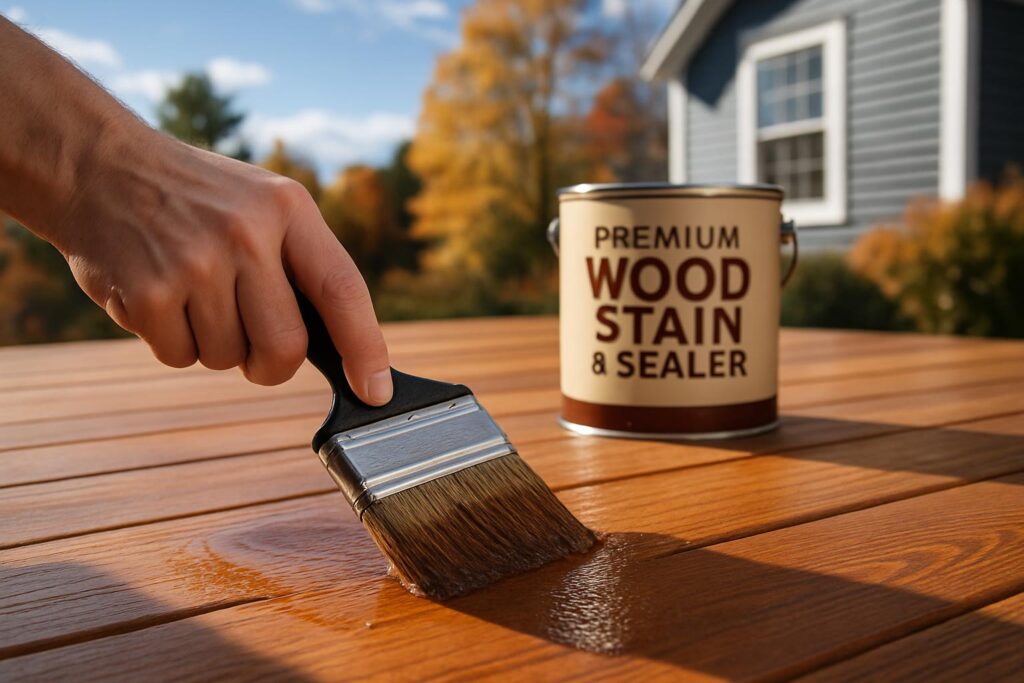
Step 5: Curing Time and Final Inspection
After application, curing time is vital. We inform the client about the time needed for the deck to be used again, ensuring the sealant has time to cure and harden properly, maximizing its longevity.
How Much Does Deck Staining Cost in Boston, MA?
The cost of staining and sealing a deck in the Boston area varies significantly based on several factors, including the deck’s size, the current condition of the wood, and the type of product chosen.
Comparative Cost Table: DIY vs. Professional
While DIY may seem cheaper initially, hiring a professional and experienced team like Boston Paint & Power ensures superior quality work, durability, and, most importantly, avoids costly preparation and application errors.
| Cost Factor | DIY (Do It Yourself) | Professional (Boston Paint & Power) |
|---|---|---|
| Cost per Square Foot (SF) | $0.50 – $1.50 (Materials only) | $2.02 – $3.30 (Premium materials and labor) [6] |
| Time Required | 2-4 days (including drying) | 1-2 days (depending on size) |
| Preparation Quality | Variable, high risk of failure | Meticulous, ensures longevity |
| Warranty | None | Service and satisfaction guarantee |
| Equipment | Rental or purchase of power washer, sander, etc. | State-of-the-art professional equipment |
For an average-sized deck (12×12 feet), the total cost in the Boston area can range from $800 to $1,350 for a complete professional service, depending on complexity [7].
Factors Influencing the Final Price
- Size and Geometry: Larger decks and those with many railings or details require more time and material.
- Current Wood Condition: Heavily degraded decks requiring heavy sanding, extensive repairs, or removal of multiple layers of old sealant will have a higher cost.
- Type of Sealant: High-quality oil-based or hybrid sealants, which offer greater durability in the New England climate, are more expensive than basic products.
- Power Washing: The inclusion of a professional and safe power washing service is an essential component of the cost.
Frequently Asked Questions (FAQ) About Deck Staining
We have optimized these questions and answers to capture Google’s featured snippets, providing direct and high-quality responses.
What is the best time to stain a deck in Boston?
The best time to stain a deck in Boston is in late spring or early fall. It is crucial that the air and wood surface temperature is between 50°F and 90°F (10°C and 32°C) and that there is no rain forecast for at least 48 hours after application. Warm, dry summer weather is also ideal, but avoid applying under direct, strong sun, which can cause the sealant to dry too quickly [8].
How often should I seal my deck in Massachusetts?
Due to the extreme New England climate, most decks in Massachusetts should be sealed or stained every 1.5 to 2 years if a high-quality semi-transparent sealant is used. Clear sealants may require annual reapplication. The simple water test (if water is absorbed by the wood instead of beading up) indicates it’s time to reseal.
Can I stain a newly built deck?
Not immediately. Newly built decks, especially those made of treated pine, need a “curing” or weathering period of 3 to 6 months before being stained. This allows the treatment chemicals to stabilize and the wood to dry completely. Trying to seal too early can trap moisture and cause premature sealant failure.
Which is better: oil-based or water-based sealant for decks in Boston?
For the Boston climate, oil-based sealant is often preferred by professionals because it penetrates deeper into the wood, offering superior protection against moisture and the freeze-thaw cycle. However, modern hybrid sealants (oil-water) offer an excellent compromise, combining the durability of oil with the ease of application and cleanup of water.
Conclusion: Protect Your Investment with Boston Paint & Power
Staining and sealing your deck is an essential investment to protect your home in the Boston area against the elements. It’s not just about aesthetics, but about preserving the structural integrity and value of your property.
At Boston Paint & Power, we combine premium materials with a professional and experienced team and a meticulous process of surface preparation. Our attention to detail and care for the client’s property ensure that your deck not only looks beautiful but also withstands the test of time and the New England weather.
Don’t leave your deck vulnerable to another Massachusetts winter.
Call-to-Action:
Ready to Protect Your Deck?
Contact Boston Paint & Power today to schedule a free deck assessment. Our specialized team in deck staining and sealing in Boston, MA, will ensure your outdoor space is protected and ready to enjoy for years to come.
Call now: 617-283-3617
Or request an online quote: https://bostonpaintandpower.com/contact/